May 2026-05-15
The packaging floor at peak season tells a familiar story. Orders stack up faster than they can ship. The semi-automatic sheet laminator, a workhorse for the past decade, chokes on a rush job. Operators scramble to adjust glue weight, realign skewed sheets, and clear jams. By the end of the shift, the output is 20% below target, and the reject pile has grown alarmingly. For many corrugated box plants, this bottleneck has been accepted as an inevitable cost of doing business. But it doesn’t have to be.
A quiet revolution is underway in the laminating department, driven not by a single breakthrough but by the steady integration of intelligent control, servo motion, and real-time quality monitoring. The result is a class of equipment that not only runs faster but also adjusts itself to maintain peak performance across different paper grades and sheet sizes. Understanding how these systems reclaim lost productivity is the first step toward a smarter, leaner finishing operation.
To see where productivity leaks away, you have to look beyond the headline speed of a machine. A laminator rated at 100 sheets per minute rarely delivers that in practice. The gap between rated speed and actual throughput is filled with micro-stops, setup changes, and rework. In manual and semi-automatic lines, the biggest culprits include:
• Feeding inconsistency. Warped or unevenly stacked sheets cause misfeeds. The machine stops. The operator realigns the pile and restarts. Over an eight-hour shift, these interruptions can consume 45 to 60 minutes.
• Glue application variance. Roller-type glue units without automatic viscosity control apply too much adhesive to some sheets and too little to others. Excess glue bleeds through lightweight liners or causes warping. Insufficient glue leads to delamination and returns.
• Registration drift. Printed sheets that slip out of alignment during lamination create visible misregistration, scrapping entire batches. Recovering alignment often means a full recalibration of the feeder and side lay, eating into productive time.
• Long changeover intervals. Switching from a 600gsm grey board to a 350gsm coated liner means adjusting roller gaps, glue volume, pressure, and delivery stacker settings. On a conventional machine, this can take 15 to 20 minutes. With multiple grade changes per shift, it’s easy to lose two hours of production.
These problems are not caused by operator negligence. They are built into the mechanical limitations of older equipment. Addressing them requires more than training; it demands a fundamentally different approach to machine design and control.
When a laminating line moves from manual setpoints to closed-loop electronic control, the sources of inefficiency begin to disappear. Sensors measure sheet thickness, glue film weight, and registration in real time. Servo drives respond instantly, correcting deviations before they become defects. This shift creates a compounding improvement in overall equipment effectiveness (OEE).
Consider feeding. Modern automated sheet-to-sheet laminating technology uses a non-stop feeder with a pre-stacking table and a double-sheet detector. The feeder continuously supplies the line without pausing for pile changes. Suction belts and air separation ensure that even slightly curled or porous sheets are picked singly, reducing mispick-related stoppages by over 70% in many installations.
Glue application benefits from closed-loop viscosity control. A sensor in the glue tray monitors viscosity continuously and dispenses water or fresh adhesive to maintain the target window. Coupled with anilox roller or precision doctor blade systems, the glue film thickness remains consistent regardless of ambient temperature or humidity. The payoff is twofold: adhesive consumption drops by 15–25%, and lamination bond strength becomes uniform enough to eliminate waste caused by variable adhesion.
Registration accuracy enters a new realm with servo-driven side lays and front lays. Optical sensors detect the printed register mark on each sheet and micro-adjust the lay position in milliseconds. The system compensates for minor sheet-to-sheet variations without stopping, which means a plant running 8,000 sheets per hour can maintain registration within ±0.3 mm consistently. That level of precision directly reduces the internal reject rate and the number of customer complaints about misaligned graphics.
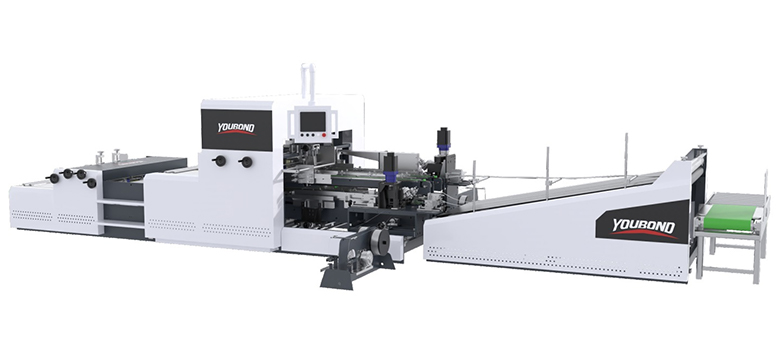
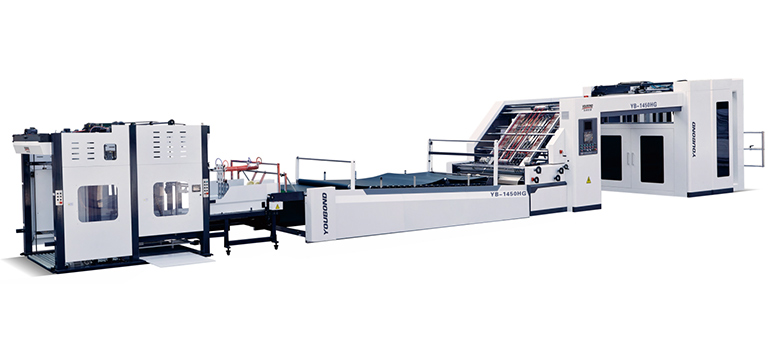
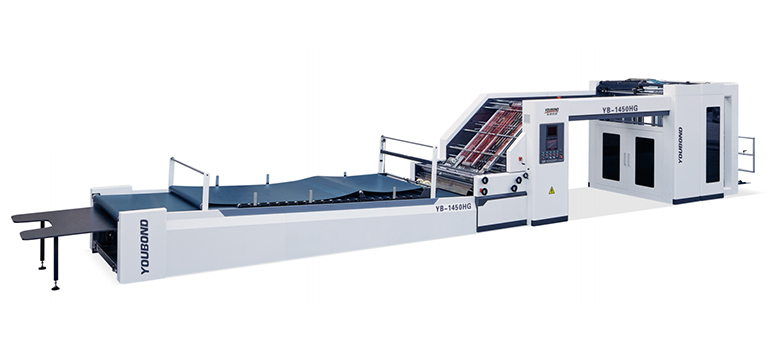
Speed itself also benefits. Because the machine self-adjusts, it can safely run at 90–100 meters per minute without the risk of cascading errors that force an operator to slow down a manual line. And when changeovers come, the recipe management function recalls stored parameters for each board grade. What used to take 20 minutes becomes a one-button job completed in under three. To understand how these features are engineered into a single integrated platform, you can see how YONGBANG’s laminating systems achieve consistent output under demanding production conditions.
Not all intelligent laminators are created equal. The features that deliver the most impact on daily productivity are often those that handle variability with minimal human input. When evaluating options, packaging converters should pay close attention to five core capabilities.
1. Automatic sheet alignment and skew correction. Independent servo control of the side lay and front lay enables continuous micro-adjustments. This eliminates the need for an operator to constantly watch and nudge sheets, freeing them to oversee multiple machines or perform quality checks.
2. Non-contact glue application with wash-free design. Some advanced machines now use slot-die coating or curtain coating instead of roller application. These methods apply an even, thin film without the glue roll picking up paper dust. The glue unit can run for an entire shift without cleaning, reducing downtime further.
3. Intelligent waste ejection. Instead of stopping the line when a faulty sheet is detected, a smart system diverts it to a reject pile without breaking the production flow. This preserves the rhythm of the line and prevents the cascade effect of a single stop disrupting downstream stacker timing.
4. Energy-efficient servo drives. Replacing a main motor and mechanical line shaft with independent servo motors reduces energy consumption by about 20–30% while improving acceleration and deceleration profiles. Softer starts and stops also reduce wear on belts and chains, cutting maintenance intervals.
5. Remote diagnostics and data logging. Built-in IoT modules record production counts, downtime causes, and glue consumption trends. Managers can access this data from a dashboard to identify patterns—such as recurring misfeeds on a particular grade—and address root causes rather than firefighting symptoms.
Each of these features contributes incrementally, but together they form a system where the machine actively supports the operator’s decision-making. It’s a shift from reactive troubleshooting to proactive process control. For a closer look at how such capabilities are being implemented today, you can discover the latest advancements in automated laminating and what they mean for real-world throughput.
Investing in a smarter laminator isn’t simply a matter of comparing maximum speeds. The fastest machine on paper can become the slowest in reality if it can’t handle the mix of substrates your orders demand. Before committing to a purchase, plant managers should ask three operational questions.
First, what is the actual board grade range you run—and what might you run in two years? A machine designed for 300–800gsm that struggles with lightweight 180gsm liners will limit your ability to take on higher-margin retail packaging work. Look for a wide operational window with automated adjustment, so you don’t face a harsh trade-off between speed and versatility.
Second, how does the machine integrate with your existing pre-feeder and stacker? Bottlenecks often shift upstream or downstream after an upgrade. An intelligent laminator may be capable of 10,000 sheets per hour, but if your automatic pre-feeder can only supply 7,000, you’ve simply relocated the bottleneck. A system-level view, rather than a machine-level view, yields better return on investment.
Third, what level of after-sales support and remote service is available? Even the most reliable equipment requires periodic maintenance. Access to remote troubleshooting, spare parts within 48 hours, and local service engineers determines how quickly you recover from a breakdown. Downtime costs can exceed €1,000 per hour in a high-volume plant, so service responsiveness is a critical efficiency metric in its own right.
By answering these questions honestly, converters can avoid buying a machine that looks impressive in a brochure but underdelivers on the production floor. The best solutions are those that match the real complexity of the job, not an idealised set of perfect conditions.
The decision to move to intelligent sheet laminating is as much about business strategy as it is about engineering. In a market where delivery windows are shrinking and customers increasingly demand just-in-time orders with zero defects, laminating lines that require constant operator intervention become a competitive liability. Those that run with minimal supervision, adapt to grade changes in seconds, and provide data to drive continuous improvement become a strategic asset.
It’s worth remembering that efficiency gains compound. A 20% increase in net throughput, combined with 15% less glue consumption and a 60% reduction in internal rejects, doesn’t just improve the laminating department—it smooths the entire conversion workflow. Downstream die-cutting and folder-gluer operations receive flatter, better-bonded sheets, reducing their own stoppages. The ripple effect through the plant can be substantial enough to delay or eliminate the need for a costly building expansion.
For converters ready to take that step, selecting a partner with deep application knowledge is key. YONGBANG has focused on the specific challenges of cardboard lamination, engineering machines that combine heavy-duty construction with intelligent control. If you’re mapping out your next capital expenditure and want to see what kind of throughput improvement is realistic for your particular mix, you can explore YONGBANG’s range of intelligent laminators and get a clearer picture of the possibilities. The goal isn’t just a faster machine—it’s a finishing line that turns variability into a manageable variable, shift after shift.
GET A QUOTE
 English
 China
China