Aug 2026-08-24
In flute laminating, two problems dominate production quality concerns: laminating accuracy and bonding quality. When a high-speed flute laminating machine runs at full capacity — modern machines can reach speeds of 10,000 sheets per hour or more — even minor issues in either area can result in massive waste, rework, and customer rejections.
The core problem is this: laminating accuracy and bonding quality are not independent variables. They are interconnected results of multiple factors — machine feed and positioning mechanisms, adhesive application, pressure roller settings, and material conditions. Understanding the root causes of each problem is the key to resolving them quickly and maintaining consistent output at high speed.
This article explains the most common causes of laminating accuracy problems and bonding quality issues on high-speed flute laminating machines, provides practical diagnostic checklists, and helps you determine when to make adjustments in-house versus when to seek professional support.
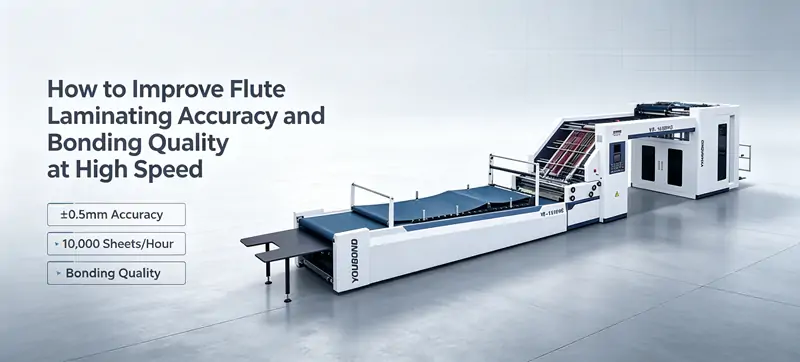
Laminating accuracy refers to the precision with which the top sheet (face paper) is aligned to the bottom sheet (corrugated board or gray board) during lamination. In a modern flute laminating machine, accuracy is typically expected to be within ±1mm. YOUBOND's high-speed flute laminating machine, equipped with a motion tracing position system and servo correction technology, achieves ±0.5mm accuracy. When accuracy drifts beyond this range, the finished product is rejected.
Here are the most common causes of laminating accuracy problems:
The paper feeding and positioning mechanism is the foundation of laminating accuracy. When this system is not properly adjusted or maintained, accuracy problems follow.
Common issues:
Solution:
The material itself can be a source of accuracy problems, especially when running at high speed.
Common issues:
Solution:
Modern flute laminating machines use photoelectric sensors for precise alignment. When these sensors are dirty or misaligned, accuracy suffers.
Common issues:
Solution:
Bonding quality refers to the strength and consistency of the adhesive bond between the face paper and the corrugated board. Poor bonding quality manifests as delamination (layers separating), bubbles (localized lack of adhesion), edge separation, or washboarding (surface ripples).
Here are the most common causes of bonding quality problems:
Adhesive mismanagement is the most common cause of downtime in flute laminating.
Common issues:
Solution:
The pressure rollers that bond the face paper to the corrugated board must apply consistent pressure across the full width.
Common issues:
Solution:
At high speeds, bonding quality can suffer if the machine is not properly configured.
Common issues:
Solution:
| Symptom | Most Likely Cause | What to Check |
|---|---|---|
| Sheets consistently misaligned by more than ±1mm | Feeding chain loose or front gauges loose | Inspect and tighten feed mechanism |
| Alignment error increases at higher speed | Thin/curled face paper | Reduce speed or pre-process paper |
| Intermittent misalignment | Dirty photoelectric sensors | Clean sensors and check brackets |
| Bubbles or washboarding on surface | Excessive glue application | Reduce adhesive quantity |
| Edge delamination or weak bond | Insufficient glue or incorrect nip gap | Check glue volume and nip gap |
| Uneven bonding across sheet width | Uneven glue film or pressure | Check roller gap and pressure both sides |
| Crushed flute on corrugated board | Nip gap too small | Increase nip gap |
If you need professional assistance with diagnosis, YOUBOND's after-sales support team is available to help.
| Issue Type | In-House Fix | Professional Support Needed |
|---|---|---|
| Feeding chain adjustment | ✓ Regular inspection and tightening | If chains are worn or damaged |
| Front gauge adjustment | ✓ Check and tighten | If components need replacement |
| Photoelectric sensor cleaning | ✓ Regular cleaning | If sensors are faulty |
| Glue quantity adjustment | ✓ Adjust based on paper type | If adhesive quality is consistently poor |
| Nip gap adjustment | ✓ Adjust to board thickness | If pressure cannot be balanced |
| Persistent accuracy problems after adjustments | — | ✓ Full diagnostic and repair |
For most flute laminating applications, accuracy within ±1mm is acceptable. High-end machines like YOUBOND's high-speed flute laminating machine achieve ±0.5mm. If accuracy consistently exceeds ±1mm, investigate the feed mechanism and sensor systems.
Bubbles are usually caused by excessive adhesive application. When too much glue is applied, the paper absorbs excess moisture, swells, and then contracts during drying, creating localized separation. Reduce adhesive quantity and ensure even application.
Run a test with the same glue but adjust the nip gap. If the problem improves with a different gap setting, the issue is pressure-related. If the problem persists regardless of pressure, the issue is likely adhesive-related.
Clean photoelectric sensors daily, or at minimum at the start of each shift. Dust and debris accumulation is one of the most common causes of intermittent alignment errors.
The most common cause is mechanical — specifically, a loose feeding chain mechanism or loose front gauges. Regular inspection and maintenance of the feeding and positioning mechanism is the most effective way to prevent accuracy problems.
Laminating accuracy and bonding quality are the two pillars of successful flute laminating production. Accuracy problems usually trace back to the feeding and positioning mechanism — loose chains, loose gauges, or dirty sensors. Bonding quality problems typically originate from adhesive mismanagement or incorrect pressure roller settings.
The key to maintaining both at high speed is regular, systematic inspection and maintenance, combined with proper material handling and adhesive control. Don't wait for visible quality problems to emerge — by then, waste has already accumulated.
If your flute laminating machine is experiencing persistent accuracy or bonding quality problems despite routine adjustments, it may be time for a professional assessment. YOUBOND's technical engineers, each with over 10 years of experience, provide timely solutions to laminating challenges.
Review the full range of YOUBOND flute laminating machine configurations to understand the available options for your production needs. For specific accuracy or bonding quality issues, contact our team directly.
GET A QUOTE
 English
 China
China