Aug 2026-08-06
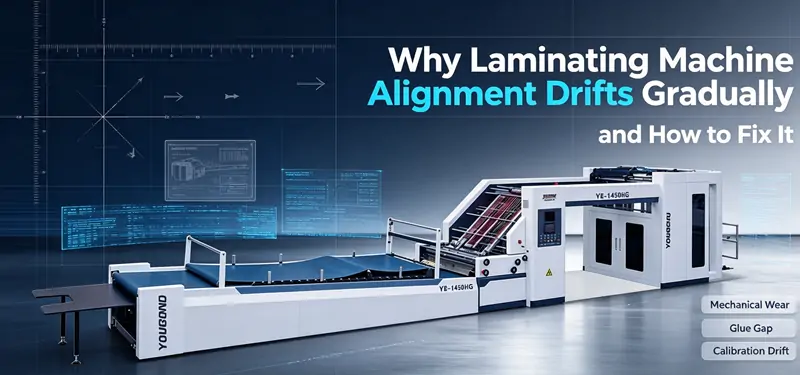
When a laminating machine starts producing sheets where the top and bottom layers don't align properly, the cause is rarely a single component failure. More often, accuracy degrades gradually as settings drift, components wear, or routine maintenance gets overlooked.
The core problem is this: alignment drift is not a sudden failure — it is a gradual loss of precision that accumulates over time. Understanding why this happens is the first step toward preventing it.
This article explains the most common causes of gradual alignment drift in flute laminating machines, provides a practical diagnostic checklist, and helps you decide when to adjust in-house versus when to seek professional support.
Alignment drift rarely has a single root cause. In most cases, multiple factors contribute over time. Here are the most common ones:
The paper feeding and positioning mechanism is the foundation of laminating accuracy. Over time, chain mechanisms can loosen, causing inconsistent or unstable operation between upper and lower chains. When the front regulations on the upper and lower chains loosen, the paper can shift during feeding, creating cumulative alignment errors.
Similarly, misaligned transfer belts can cause skewed stacks that downstream equipment rejects. These mechanical issues often develop gradually — a millimeter here, a millimeter there — until the accumulated error becomes visible in the finished product.
The glue application section is often overlooked as an alignment factor, but an uneven glue film can cause sheets to shift during lamination. If the glue roll gap is wider on the operator side than the drive side, the fluting may receive a thicker adhesive layer on one edge, causing the sheet to pull unevenly as it moves through the press section.
Adhesive buildup on application rollers is one of the most common root causes of sheet delamination and misalignment. When cleaning intervals are set by guesswork rather than by actual production conditions, buildup accumulates gradually until it affects both alignment and bond quality.
Incoming materials with inconsistent thickness, moisture content, or surface smoothness can cause problems during lamination. Warped or damaged boards can cause misalignment during the process. These material issues may not cause immediate failure but can gradually degrade alignment accuracy over a production run.
Even the most precise machine loses calibration over time. Temperature changes, vibration, and normal operation all contribute to gradual calibration drift. When the machine is not regularly recalibrated, small errors accumulate until they become production problems.
If you suspect your laminating machine is experiencing alignment drift, follow this diagnostic process:
| Step | Action | What to Look For |
|---|---|---|
| 1 | Run a single sheet through the entire machine path — glue unit, pressing section, conveyor, and stacker — without printing or bottom board | Check if the sheet tracks straight from start to finish |
| 2 | Measure alignment at multiple points along the machine | Identify where drift first appears |
| 3 | Check glue roll gap on both sides | Uneven gap indicates glue application issues |
| 4 | Inspect feed chains and belts for looseness or wear | Loose chains cause inconsistent feeding |
| 5 | Verify machine leveling | Uneven surfaces cause vibration and misalignment |
| 6 | Review cleaning and maintenance logs | Irregular maintenance often correlates with drift |
If you need professional assistance, YOUBOND's after-sales support team is available to help.
Many alignment issues can be resolved through routine maintenance and calibration. However, some situations require professional intervention.
| Issue Type | In-House Fix | Professional Support Needed |
|---|---|---|
| Glue roll gap adjustment | ✓ Regular cleaning and gap checks | — |
| Chain tension adjustment | ✓ If within normal range | If chains are worn or damaged |
| Calibration drift | ✓ If you have documented procedures | If drift persists after recalibration |
| Worn components | — | ✓ Replacement of feed chains, belts, or rollers |
| Persistent misalignment after adjustments | — | ✓ Full diagnostic and repair |
Preventing alignment drift is far more cost-effective than correcting it after production quality has been compromised. Use this checklist to maintain laminating accuracy:
• Daily: Clean glue application rollers to prevent adhesive buildup
• Daily: Check for visible misalignment in the first few sheets of each run
• Weekly: Inspect feed chains and belts for looseness or wear
• Weekly: Verify glue roll gap is even on both sides
• Monthly: Run a full machine path test with a single sheet
• Monthly: Check machine leveling
• Quarterly: Full calibration check of all alignment systems
• Annually: Professional inspection of worn components
Q: How can I tell if alignment drift is mechanical or material-related?
Run the same job with a different batch of material. If the problem persists, it is likely mechanical. If it resolves, the issue was material-related.
Q: How often should I recalibrate my laminating machine?
Recalibration frequency depends on production volume and material types. As a general rule, perform a full calibration check quarterly, with weekly spot checks.
Q: Can uneven glue application really cause alignment problems?
Yes. An uneven glue film creates uneven pull on the sheet as it moves through the press section. This is one of the most overlooked causes of gradual alignment drift.
Q: What is the most common mechanical cause of alignment drift?
Loose or worn feed chains and belts are among the most common causes. Regular inspection and timely replacement prevent gradual drift.
Q: When should I consider replacing rather than repairing alignment components?
When repair costs approach 50% of replacement cost, or when the machine has required alignment adjustments more than three times in six months.
Laminating machine alignment drift is not a mystery — it is the predictable result of gradual wear, inconsistent maintenance, and cumulative calibration error. The key to preventing it is regular, systematic inspection and maintenance, not waiting for visible quality problems to emerge.
If your laminating machine is experiencing persistent alignment drift despite routine adjustments, it may be time for a professional assessment. YOUBOND's technical engineers, each with over 10 years of experience, provide timely solutions to alignment and other production challenges. For specific alignment issues or technical support, contact our team directly.
GET A QUOTE
 English
 China
China